



An Eclectic Mix of Homes in Bicycle City
By Bicycle City Staff, Updated Tue, 06/17/2008 - 10:11
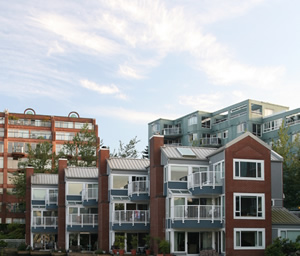 Bicycle City does not want to be another community full of cookie-cutter homes. Rather, we want our single-family homes, townhomes, apartments, lofts and other dwellings to reflect our eclectic spirit and champion individuality. We plan to offer eco-friendly multi-unit dwellings and traditional-style single family housing - unique home options that appeal to our environmentally-conscious, active residents.
Regardless of what our houses end up looking like, we plan to have all of them be LEED certified. The US Green Building Council has established a point system for awarding LEED certification for homes, as outlined in the Green Home Guide:
- Innovation and Design Process: Points for project planning, durability planning and management, innovation and design
- Location and Linkages: Points for neighborhood development, site selection, infrastructure, community resources, transit availability and open space
- Sustainable Sites: Points for erosion control, landscaping, reducing heat effects, permeability, pest control alternatives and density
- Water Efficiency: Points for the reuse of water, irrigation and high-efficient fixtures and fittings
- Energy and Atmosphere: Points for energy efficiency, hot water distribution, pipe insulation and HVAC refrigerants
- Materials and Resources: Points for framing, tropical wood, eco-friendly building products and waste management planning and reduction
- Indoor Environmental Quality: Points for venting, moisture control, air ventilation, exhaust, heating and cooling load calculations, air filtering, containment control, radon protection and garage pollutant protection
- Awareness and Education: Points for educating the home owner, tenant or building manager
Dwellings Statistics
- Only 7.2% of home buyers believe developers pay enough attention to the environment. (RCLCO “Measuring the Market for Green Residential Development”)
- 20% of homeowners feel their homes have a negative impact on the environment and want to do something to reduce their impact either in their existing home or on a future purchase. (RCLCO “Measuring the Market for Green Residential Development”)
- 43% want their homes to save more energy. (RCLCO “Measuring the Market for Green Residential Development”)
- In their next home purchase, 40.1% want better insulation, 34.5% want whole-home air filtering, 29.1% want water conserving fixtures, 20% want a reduction of energy, 22% want improved indoor air quality, and 19.8% wants water conservation, renewable energy and resource conservation. (RCLCO “Measuring the Market for Green Residential Development”)
- If the investment pays itself off over time, 75% of buyers will spend more for a green home if it saves energy; 50% will if it provides health benefits and 46% will if it is good for the environment. (RCLCO “Measuring the Market for Green Residential Development”)
- If the investment may not pay itself off over time, only 18% will spend additional money to save energy, 41% will if it provides health benefits, and 24% will if it is good for the environment. (RCLCO “Measuring the Market for Green Residential Development”)
- The potential demand for high-density housing is in the range of 4.5 million units over the next 10 years. (RCLCO “Measuring the Market for Green Residential Development”)
- There are over 11,390 homes across the U.S. involved in the LEED for home pilot program; 502 homes have already received LEED certification. (US Green Building Council)
- The green homes market is expected to increase to 10% by 2010. (US Green Building Council)
- 2%–or $7.4 billion–of homes were built green (2006) with elements such as energy efficient windows. 0.3% of all existing United States homes are truly green, constructed using several different green building design features and products, a market sized at approximately $2 billion. (NAHB and McGraw-Hill Construction)
- 85% of green homeowners are more satisfied with their new green homes than with their previous, more traditionally built homes. (NAHB and McGraw-Hill Construction)
- 63% report lower operating and maintenance costs as the key motivation behind buying a green home. Additionally, nearly 50% said they are motivated by environmental concerns and their family’s health. (NAHB and McGraw-Hill Construction)
- 40% of those who have recently completed home remodeling or renovation work in their homes reported that they used green products or materials. (NAHB and McGraw-Hill Construction)
- 52% of corporate respondents and 39% of developer respondents currently own manage or lease some green property. (National Real Estate Investor 2007 Green Building Survey)
- 84% corporate respondents/77% development respondents expect to own, manage or lease some green property within five years. (National Real Estate Investor 2007 Green Building Survey)
- 3,200 buildings (575 million square feet) have the Energy Star seal of approval. (National Real Estate Investor 2007 Green Building Survey)
- Corporate users anticipate green facilities that they own or lease will more than double from 9% to 21% in next five years. (National Real Estate Investor 2007 Green Building Survey)
- Developers expect the volume of green properties in their portfolios to jump from 9% to 20% by 2012. (National Real Estate Investor 2007 Green Building Survey)
- 46% corporate users/51% development respondents consider green design either important or extremely important. (National Real Estate Investor 2007 Green Building Survey)
- Only 10% of developers say green design is not at all important in the site selection process.
- When choosing green buildings to buy/lease, the most important factors to corporate users are energy efficiency (81%), water savings (53%) and indoor environmental quality (50%).(National Real Estate Investor 2007 Green Building Survey)
- When building green, the most important factors are lower energy costs (79%) and being environmentally friendly (74%).(National Real Estate Investor 2007 Green Building Survey)
Site Map:
